
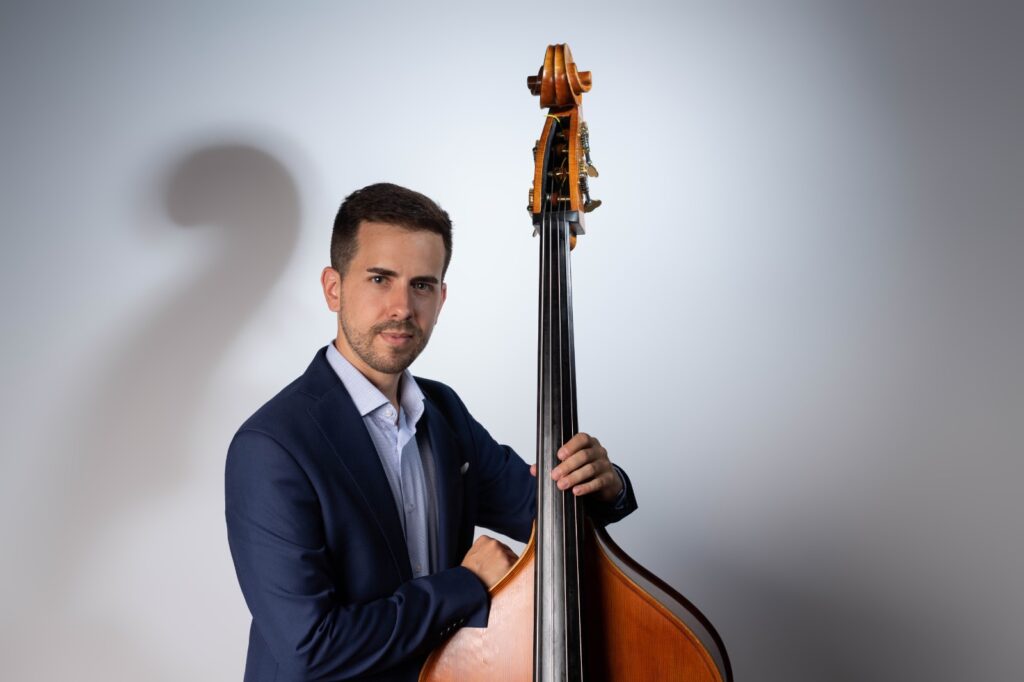
By Antonio Torres Olmo, Double bass professor in Sevilla.
The following article outlines a core element of my teaching at the Conservatorio Superior de Música de Sevilla, where I serve as Professor of Double Bass. It presents one of the key pillars of my pedagogical approach. As this is one of the pillars of my pedagogy, the results that my students have achieved, testify the success of this system.
First and foremost, I would like to emphasize that the daily practice routine I am about to share is simply a comprehensive system, synthesized to the fullest, to keep all fundamental aspects of daily work close at hand. It is not the only path to get excellent results; however, if you are not already following a comparable structured routine, it is essential to find one that allows you to address every foundational area.
Consistency, active study, and deep reflection on every exercise will help the double bassist to achieve the greatest success in their evolution. Following the model of “deliberate practice” (Ericsson et al., 1993), the quality of critical thinking during exercise is as vital as the physical repetition itself. Indeed, students who have utilized this methodology have gone on to collaborate with world-renowned ensembles, including the Berliner Philharmoniker, Symphonieorchester des Bayerischen Rundfunks, Orchestre de l’Opéra national de Paris, Orchestre Philharmonique de Radio France, Rotterdam Philharmonic Orchestra, and the Spanish National Orchestra (ONE), among others.
Finally, I invite the readers to reflect on the parallels between music and high-performance sports. Current performing arts medicine frequently describes musicians as “small-muscle athletes” (Brandfonbrener, 1991). Just as elite tennis or football players do not limit their training solely to ball handling or match simulations, the musician must adopt a holistic system. Athletes monitor their nutrition, sleep hygiene, muscle development, endurance, and specific technique (Hildebrandt, 2009). We should draw inspiration from this multidimensional discipline and adapt it to our daily craft to achieve what Williamon (2004) defines as “musical excellence.”
The following sections outline the specific routine we utilize at the Conservatorio Superior de Música de Sevilla; it may be helpful to vary the order of the blocks daily, so the work does not always follow the same sequence and become too monotonous:
Warm-up and Stretching
It is recommended to follow a warm-up routine before starting and a stretching routine after finishing your daily practice (numerous routines are available online).
TECHNIQUE (Minimum 2 hours daily)
Exercises should be performed in front of a mirror with maximum concentration. Do not execute them mechanically; reflect on every detail. The study is divided into four blocks:
Block 1 – Open Strings
Perform the exercise first with a metronome, then without it. I recommend to increase the duration of each bow stroke daily.
- Seek a continuous sound, achieving the maximum power the bass allows, while maintaining optimal relaxation and playing very close to the bridge.
- Repeat the exercise from a more comfortable contact point, this time focusing on maximum sound quality.
Block 2 – Daily Left-Hand Exercises
- Work through the exercise sheet titled Ejercicios diarios de mano izquierda [daily left-hand exercises] (Torres Olmo, 2022) at a slow tempo with good tone, observing every detail.
- To automate left-hand movements, it is also recommended to play the sheet while focusing your attention entirely on the bow.
Block 3 – Scales and Arpeggios
- One different scale per day. Procedure for practicing the scale:
- Play the tonic of the scale as a drone/fixed note (using a phone, computer, etc.) while playing the scale. Work at a slow tempo using the full bow. Pay close attention to bow changes and verify the correct relaxation and natural movement of the shoulder, elbow, wrist, and fingers.
- Perform the same scale without the reference note.
- Scale Variations: Choose at least two different variations per day for the selected scale (Torres Olmo, 2023).
- Study the primary arpeggios of the selected scale. It is recommended to look for fingerings based on patterns.
- Block Scales Sheet (Torres Olmo, 2023): Alternate between different versions (e.g., major scales one day, minor the next). Respect the indicated tempo and always use the full bow.
Block 4 – Etudes and Technical Reinforcement
- Etudes: Work on at least one etude per week. Recommended examples of technical etudes include works by Hrabě (1954), Mengoli (1950), Caimmi (1924), Billè (1921), and others.
- Study at least one exercise per week from the book Simplified Higher Technique (Petracchi, 1982).
- Review and Reinforcement: Address specific areas for personalized improvement (e.g., vibrato improvisation, tension review, spiccato, sound quality, etc.).
REPERTOIRE (Minimum 2 hours daily)
- Orchestral Excerpts: Study at least two new excerpts per week in addition to reviewing the two previously studied excerpts, utilizing the reference Orchester-Probespiel: Kontrabass (Reinke & Stoll, 1986). (30 minutes).
- Solo Repertoire: (1 hour and 30 minutes).
Bibliographic References
Billè, I. (1921). Nuovo metodo per contrabbasso [Nuevo método para contrabajo]. Ricordi.
Brandfonbrener, A. G. (1991). The medical problems of musicians. Scientific American, 264(3), 50-59. https://doi.org/10.1038/scientificamerican0301-50
Caimmi, I. (1924). La tecnica superiore del contrabbasso [La técnica superior del contrabajo]. Ricordi.
Conservatorio Superior de Música de Sevilla. (2024). Guía docente de la asignatura de Contrabajo [Teaching guide for Double Bass]. Recuperado de https://consev.es/
Ericsson, K. A., Krampe, R. T., & Tesch-Römer, C. (1993). The role of deliberate practice in the acquisition of expert performance. Psychological Review, 100(3), 363-406. https://doi.org/10.1037/0033-295X.100.3.363
Hildebrandt, H. (2009). Physical conditioning for musicians. En A. Williamon (Ed.), Musical excellence: Strategies to achieve peak performance (pp. 141-155). Oxford University Press.
Hrabě, J. (1954). 82 Etudes for Double Bass (Vols. 1-2). International Music Company. (Obra original publicada c. 1850).
Mengoli, A. (1950). 20 Concert Studies for Double Bass (F. Warnecke, Ed.). International Music Company.
Petracchi, F. (1982). Simplified higher technique for double bass. Yorke Edition.
Reinke, G., & Stoll, K. (Eds.). (1986). Orchester-Probespiel: Kontrabass [Test pieces for orchestral auditions: Double bass]. Schott.
Torres Olmo, A. (2022). Ejercicios diarios de mano izquierda [Unpublished manuscript]. Conservatorio Superior de Música de Sevilla.
Torres Olmo, A. (2023). Variaciones de escalas [Unpublished manuscript]. Conservatorio Superior de Música de Sevilla.
Torres Olmo, A. (2023). Escalas por bloques [Unpublished manuscript]. Conservatorio Superior de Música de Sevilla.
Williamon, A. (Ed.). (2004). Musical excellence: Strategies to achieve peak performance. Oxford University Press.